%20--%3e%3csvg%20width='63.297821mm'%20height='39.29665mm'%20viewBox='0%200%2063.297821%2039.29665'%20version='1.1'%20id='svg8765'%20inkscape:version='1.1%20(c4e8f9ed74,%202021-05-24)'%20sodipodi:docname='OBALogoSingle2.svg'%20xmlns:inkscape='http://www.inkscape.org/namespaces/inkscape'%20xmlns:sodipodi='http://sodipodi.sourceforge.net/DTD/sodipodi-0.dtd'%20xmlns='http://www.w3.org/2000/svg'%20xmlns:svg='http://www.w3.org/2000/svg'%3e%3csodipodi:namedview%20id='namedview8767'%20pagecolor='%23ffffff'%20bordercolor='%23666666'%20borderopacity='1.0'%20inkscape:pageshadow='2'%20inkscape:pageopacity='0.0'%20inkscape:pagecheckerboard='0'%20inkscape:document-units='mm'%20showgrid='false'%20fit-margin-top='0'%20fit-margin-left='0'%20fit-margin-right='0'%20fit-margin-bottom='0'%20inkscape:zoom='1.1759259'%20inkscape:cx='179.85827'%20inkscape:cy='102.04724'%20inkscape:window-width='1920'%20inkscape:window-height='972'%20inkscape:window-x='0'%20inkscape:window-y='27'%20inkscape:window-maximized='1'%20inkscape:current-layer='layer1'%20/%3e%3cdefs%20id='defs8762'%20/%3e%3cg%20inkscape:label='Layer%201'%20inkscape:groupmode='layer'%20id='layer1'%20transform='translate(-31.351095,-50.101677)'%3e%3cpath%20style='fill:none;stroke:%233584e4;stroke-width:3.965;stroke-linecap:square;stroke-linejoin:round;stroke-miterlimit:4;stroke-dasharray:none;stroke-opacity:1'%20d='m%2077.07508,77.78787%2014.84134,8.87817%20V%2052.83397%20L%2034.08359,86.5521%20V%2053.69366%20l%2015.27351,9.31107'%20id='path8388'%20sodipodi:nodetypes='cccccc'%20/%3e%3c/g%3e%3c/svg%3e)
Stock Analysis Examples: Apple, Rolls-Royce, Meta & Riot
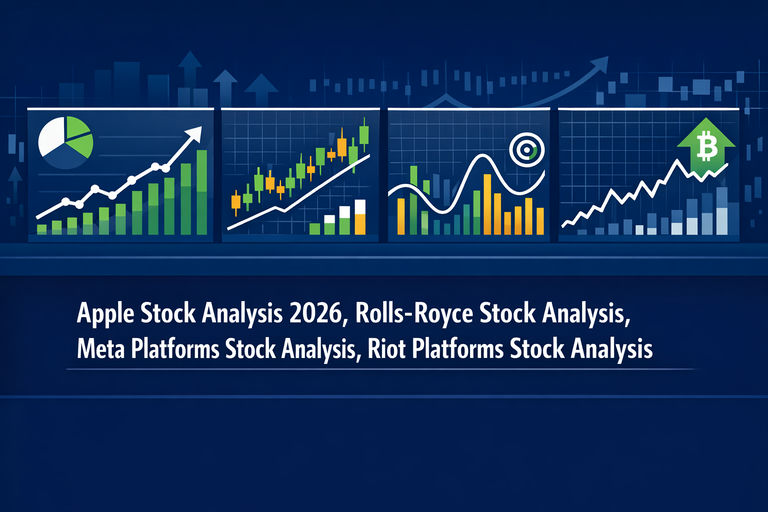
This analysis covers Apple, Rolls-Royce, Meta Platforms, and Riot Platforms — breaking down the key financial drivers, valuation signals, and risks shaping each stock in 2026.
On this page (6)
Choosing which stocks to examine closely is one of the most important decisions an investor can make — and in 2026, few conversations are more interesting than the ones happening around Apple (AAPL), Rolls-Royce (RR), Meta Platforms (META), and Riot Platforms (RIOT). These four companies span continents, industries, and risk profiles, yet each is generating serious attention from analysts and investors alike. This deep-dive apple stock analysis — alongside comparable breakdowns of Rolls-Royce, Meta, and Riot — explores the key business drivers, financial signals, and structural risks that define each company's story right now. Rather than telling you what to buy or sell, the goal here is to give you the analytical framework to think about these stocks the way a professional would.
Apple (AAPL): Navigating Valuation and AI Ambitions in 2026
Apple remains one of the most scrutinised stocks on the planet, and 2026 has done nothing to reduce that attention. The company reported iPhone revenue growing approximately 23% year-over-year as of Q1 2026, a figure that surprised many analysts who had expected the upgrade cycle to slow. Consensus revenue expectations for Q2 2026 hovered in the $109 billion range, reflecting continued strength across its hardware and services ecosystem.
Yet the valuation question looms large. Apple's trailing price-to-earnings ratio has been trading around 37x — elevated by historical standards for a company of its maturity. Analyst price targets vary widely, with the average sitting near $314 and the most bullish projections reaching $400, according to aggregated forecasts. The integration of generative AI directly into iOS is widely cited as the next potential growth catalyst, with analysts at firms like Oppenheimer projecting double-digit EPS growth through 2027 if the AI rollout gains consumer traction.
Key factors to watch in any apple stock analysis include:
- Services revenue growth: Apple's highest-margin segment continues to expand, reducing reliance on hardware cycles.
- AI monetisation: Whether Apple Intelligence features translate into meaningful upgrade demand or subscription revenue remains an open question.
- Tariff exposure: Supply chain costs tied to manufacturing in Asia remain a structural risk, with tariff policy continuing to create uncertainty around margins.
- Valuation premium: At 37x trailing earnings, the stock prices in a significant amount of future growth — leaving limited room for disappointment.
Rolls-Royce (RR): The Defence and Aerospace Turnaround Story
Few stocks in recent memory have generated as much momentum as Rolls-Royce Holdings (RR), listed on the London Stock Exchange. The company hit record highs every single trading day in early January 2026, capping a multi-year turnaround that has delivered gains of roughly 2,000% from its post-pandemic lows. CEO Tufan Erginbilgiç's restructuring programme — focused on cost discipline, margin expansion, and strategic focus — has fundamentally changed how the market prices this business.
By February 2026, Rolls-Royce reported full-year results that beat expectations and prompted management to upgrade its medium-term financial targets. A trading update in April confirmed a strong start to 2026, with the defence segment benefiting from elevated government spending across Europe and NATO allies. The company's civil aerospace division is also recovering strongly as long-haul flight hours — which directly drive engine maintenance revenue — continue to normalise post-pandemic.
For investors conducting a rolls royce stock analysis, the critical metrics to monitor are:
- Engine flying hours: Rolls-Royce earns significant revenue through long-term service agreements tied to flight hours — a unique and recurring revenue model.
- Defence order book: With European defence budgets expanding, the order pipeline is a key forward indicator.
- Free cash flow conversion: The company's ability to convert operating profit into cash has been central to the re-rating thesis.
- Currency exposure: Much of Rolls-Royce's revenue is denominated in US dollars, making GBP/USD movements a meaningful variable for reported earnings.
The stock's extraordinary run raises a legitimate question about whether the easy gains are behind it — or whether the upgraded mid-term targets justify further re-rating. That is a judgement each investor must make based on their own risk tolerance and time horizon.
Meta Platforms (META): AI Infrastructure and the Advertising Engine
Meta Platforms (META) entered 2026 on the back of a strong Q4 2025, reporting revenue of $59.9 billion — up 24% year-over-year — as its advertising business continued to benefit from AI-driven targeting improvements. The company's family of apps, including Facebook, Instagram, and WhatsApp, collectively reach billions of users, giving Meta an advertising moat that few competitors can match.
The meta platforms stock analysis picture in mid-2026 is more nuanced, however. The stock has experienced notable volatility, with META trading well below its all-time high of $796.25 reached in August 2025. The pullback reflects a combination of factors: heavy capital expenditure commitments to AI infrastructure, regulatory scrutiny in Europe and the US, and broader market rotation away from high-multiple technology names.
Meta's investment thesis rests on several pillars:
- AI-enhanced advertising: Meta's Advantage+ AI tools are reportedly driving higher return on ad spend for advertisers, which supports pricing power.
- Llama and open-source AI: Meta's decision to open-source its large language models is a strategic differentiator, building developer goodwill and reducing the cost of AI adoption across its platforms.
- Reality Labs losses: The metaverse division continues to generate significant operating losses, which remains a point of contention among investors focused on near-term profitability.
- Regulatory risk: Antitrust proceedings and data privacy regulations in multiple jurisdictions represent ongoing headline risk.
With 38 analysts covering the stock and a consensus rating of Buy, the analyst community remains broadly constructive — but the range of price targets, from $700 to $1,015, reflects genuine uncertainty about the pace of AI monetisation and the regulatory environment.
Riot Platforms (RIOT): Bitcoin Mining in a Post-Halving World
Riot Platforms (RIOT) occupies a very different corner of the investment universe. As one of the largest publicly listed Bitcoin mining companies in North America, Riot's financial performance is inextricably linked to the price of Bitcoin, the network's mining difficulty, and the company's ability to manage energy costs at scale.
In Q1 2026, Riot reported Bitcoin mining revenue of $111.9 million — down from $142.9 million in the same period of 2025, reflecting the impact of the April 2024 Bitcoin halving, which cut the block reward from 6.25 BTC to 3.125 BTC. Total Q1 2026 revenue came in at $167 million, but the company posted a GAAP net loss of $500 million and an adjusted EBITDA loss of $311 million, underscoring the capital-intensive and volatile nature of the business model.
A thorough riot platforms stock analysis must account for the following dynamics:
- Bitcoin price sensitivity: Riot's revenue and profitability are directly correlated with BTC price movements. A sustained Bitcoin rally can dramatically improve unit economics; a prolonged downturn can pressure margins severely.
- Hash rate expansion: Riot has been aggressively expanding its mining capacity. Greater hash rate improves the company's share of block rewards but also increases capital expenditure and energy consumption.
- Energy cost management: Riot operates large-scale facilities in Texas, where it benefits from power purchase agreements and demand response programmes — a structural cost advantage relative to smaller miners.
- Diversification into data centres: Riot has been positioning itself as a broader digital infrastructure company, with data centre development representing a potential revenue stream less correlated to Bitcoin price.
Analyst consensus leans toward Buy, with a 2026 price target consensus near $26.90 and a range extending to $45 on the bullish end. However, the wide dispersion of forecasts reflects the inherent difficulty of modelling a business whose primary input — Bitcoin — is itself highly unpredictable.
Comparing the Four: Risk Profiles and Investor Considerations
Placing these four stocks side by side reveals just how different the risk-return profiles can be within a single portfolio. Apple and Meta are large-cap technology companies with established revenue streams and significant free cash flow generation — but both carry valuation premiums that require continued execution to justify. Rolls-Royce is a mid-cap industrial turnaround story with genuine momentum, but one where much of the good news may already be reflected in the share price. Riot Platforms is a high-volatility, high-speculation play on the cryptocurrency ecosystem, suitable only for investors who fully understand and accept the binary nature of its risk profile.
When conducting any individual stock analysis, it is worth asking:
- What is the core business model, and how durable is the revenue stream?
- What assumptions are already priced into the current valuation?
- What are the two or three factors that could cause the thesis to break down?
- How does this position interact with the rest of my portfolio in terms of sector, geography, and risk concentration?
Conclusion: The Value of Structured Stock Analysis
Whether you are examining the AI-driven growth narrative behind Apple (AAPL), the industrial turnaround at Rolls-Royce (RR), the advertising and AI infrastructure story at Meta Platforms (META), or the Bitcoin-linked volatility of Riot Platforms (RIOT), the discipline of structured stock analysis is what separates informed decision-making from speculation. Understanding the key financial drivers, the risks embedded in the current valuation, and the macro factors that could shift the narrative is essential for any serious investor. The stocks covered here are among the most discussed in 2026 — and for good reason. Each tells a different story about where capital is flowing and why.
You can Compare AAPL, RR, META, RIOT side by side on Openbook, or find stocks with the screener.