%20--%3e%3csvg%20width='63.297821mm'%20height='39.29665mm'%20viewBox='0%200%2063.297821%2039.29665'%20version='1.1'%20id='svg8765'%20inkscape:version='1.1%20(c4e8f9ed74,%202021-05-24)'%20sodipodi:docname='OBALogoSingle2.svg'%20xmlns:inkscape='http://www.inkscape.org/namespaces/inkscape'%20xmlns:sodipodi='http://sodipodi.sourceforge.net/DTD/sodipodi-0.dtd'%20xmlns='http://www.w3.org/2000/svg'%20xmlns:svg='http://www.w3.org/2000/svg'%3e%3csodipodi:namedview%20id='namedview8767'%20pagecolor='%23ffffff'%20bordercolor='%23666666'%20borderopacity='1.0'%20inkscape:pageshadow='2'%20inkscape:pageopacity='0.0'%20inkscape:pagecheckerboard='0'%20inkscape:document-units='mm'%20showgrid='false'%20fit-margin-top='0'%20fit-margin-left='0'%20fit-margin-right='0'%20fit-margin-bottom='0'%20inkscape:zoom='1.1759259'%20inkscape:cx='179.85827'%20inkscape:cy='102.04724'%20inkscape:window-width='1920'%20inkscape:window-height='972'%20inkscape:window-x='0'%20inkscape:window-y='27'%20inkscape:window-maximized='1'%20inkscape:current-layer='layer1'%20/%3e%3cdefs%20id='defs8762'%20/%3e%3cg%20inkscape:label='Layer%201'%20inkscape:groupmode='layer'%20id='layer1'%20transform='translate(-31.351095,-50.101677)'%3e%3cpath%20style='fill:none;stroke:%233584e4;stroke-width:3.965;stroke-linecap:square;stroke-linejoin:round;stroke-miterlimit:4;stroke-dasharray:none;stroke-opacity:1'%20d='m%2077.07508,77.78787%2014.84134,8.87817%20V%2052.83397%20L%2034.08359,86.5521%20V%2053.69366%20l%2015.27351,9.31107'%20id='path8388'%20sodipodi:nodetypes='cccccc'%20/%3e%3c/g%3e%3c/svg%3e)
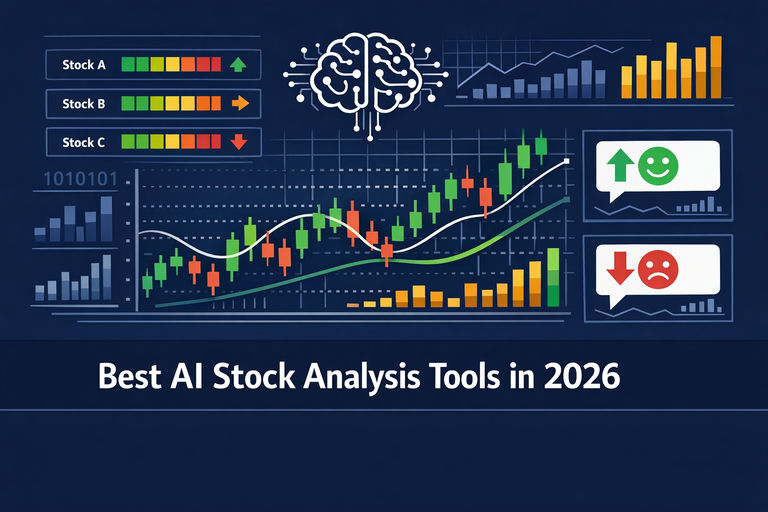
Best AI Stock Analysis Tools in 2026
AI stock analysis tools have multiplied rapidly in 2026, but not all of them are built for serious investing. This guide explains how to evaluate the best AI stock analysis tools, what separates purpose-built platforms from general chatbots, and how to build a practical research workflow using AI investing tools that match your strategy.
On this page (16)
The market for best AI stock analysis tools has exploded in 2026. There are now dozens of platforms claiming to give you an edge — from general-purpose chatbots like ChatGPT being repurposed for stock research, to purpose-built platforms with proprietary financial algorithms, to AI layers bolted onto existing brokerages. The problem is not a shortage of options. The problem is knowing how to tell a genuinely useful AI investing tool apart from one that looks impressive but falls apart when it matters. This guide cuts through the noise by giving you a practical framework for evaluating any AI stock analysis tool — and then applying that framework to the most prominent options available today.
Why Most Investors Are Using AI Stock Analysis Tools Wrong
Before comparing specific platforms, it is worth addressing a common misconception: that any AI tool is better than no AI tool when it comes to stock research. That assumption can actually be dangerous. Research published by Entrepreneur magazine found that ChatGPT gave incorrect answers on approximately 35% of financial and investing queries. A separate study found that Google Gemini hallucinated financial information at rates as high as 88–91% in some tests. When you are making investment decisions, a tool that is wrong one in three times is not a research assistant — it is a liability.
The core issue is that general-purpose AI models are trained to generate plausible-sounding text, not to perform rigorous financial analysis. They do not have access to live market data, they cannot run discounted cash flow models, and they have no way to verify the numbers they produce. Using AI to research stocks effectively means understanding which category of tool you are actually dealing with.
The Four Categories of AI Investing Tools in 2026
Not all AI stock analysis tools are built the same way. Understanding the four main categories helps you set realistic expectations before you commit to any platform.
1. General-Purpose AI Chatbots
Tools like ChatGPT (OpenAI), Google Gemini, and Perplexity AI fall into this category. They are excellent for explaining financial concepts, summarising publicly available information, and helping you think through an investment thesis in plain language. Where they fall short is in precision. They lack live market data, proprietary financial algorithms, and the ability to verify the numbers they generate. Perplexity's own CEO acknowledged on social media that the platform sometimes uses stale market data. These tools are best used as a starting point for learning, not as a primary research engine for actual investment decisions.
2. Brokerage-Integrated AI Add-Ons
Several retail brokerages have added AI features to their platforms. Robinhood Cortex, available to Robinhood Gold subscribers, uses generative AI to summarise news, analyst reports, and portfolio movements in plain language. Webull Vega and Moomoo AI offer similar functionality. The convenience of having research inside your trading app is real, but these tools come with an important caveat: brokerages make money when you trade. Their AI features are designed to keep you engaged with the platform, not necessarily to provide independent, rigorous research. Robinhood's own documentation describes Cortex digests as being provided for informational purposes only, not research — a meaningful distinction.
3. Purpose-Built AI Stock Analysis Platforms
This category includes platforms designed from the ground up for financial analysis. Tools like Danelfin, Trade Ideas, TrendSpider, and Seeking Alpha Premium use proprietary algorithms, multi-factor scoring systems, and specialised data feeds to generate structured investment insights. Danelfin, for example, assigns an AI Score to thousands of US and European stocks based on the probability of outperforming the market over the next three months, and expanded its European coverage to over 5,500 stocks in early 2026. Trade Ideas uses an AI system called Holly that runs backtests on thousands of stocks nightly to generate signals for active traders. These platforms are built for investing, not just for answering questions about investing.
4. Institutional-Grade AI Research Terminals
At the top end sits Bloomberg Terminal, which has integrated AI-powered natural language queries and summaries into its existing infrastructure. The data quality and breadth are unmatched, but the cost — typically upwards of $25,000 per year — makes it inaccessible for most individual investors. Newer entrants like Barebone AI are attempting to bring institutional-grade multi-agent research to retail investors on mobile, with specialised analytical modules covering everything from DCF valuation to insider trading disclosures and Reddit sentiment aggregation.
Five Questions to Ask Before Choosing an AI Stock Analysis Tool
Rather than simply picking the tool with the most features or the highest-profile name, use these five questions to evaluate any platform against your actual needs.
Does it use live, verified financial data?
This is the most important question. A tool that analyses stale data — even with sophisticated AI — is producing analysis based on an outdated picture of a company. Ask specifically whether the platform pulls live prices, current SEC filings, and real-time earnings estimates, or whether it is working from a training dataset with a knowledge cutoff. For long-term fundamental investors, slightly delayed data may be acceptable. For anyone tracking earnings surprises, insider transactions, or short-term price movements, real-time data is non-negotiable.
Does it have specialised financial algorithms, or is it a general language model?
There is a meaningful difference between a platform that runs a discounted cash flow model using actual financial inputs and one that generates a paragraph describing what a DCF model is. Purpose-built AI investing tools use proprietary scoring systems, technical analysis engines, and quantitative factor models. General chatbots generate text. Both can be useful, but they are useful for different things.
What type of investor is it designed for?
An active day trader and a long-term fundamental investor have almost nothing in common in terms of what they need from a research tool. Trade Ideas and TrendSpider are built for active traders who need real-time signals and technical pattern recognition. A platform like Seeking Alpha Premium, with its Quant ratings and analyst commentary, is better suited to investors doing longer-term fundamental research. Danelfin sits somewhere in between, offering AI scores that are useful for both medium-term positioning and longer-term stock selection. Matching the tool to your strategy matters more than picking the most feature-rich option.
How does it handle uncertainty and errors?
A trustworthy AI stock analysis tool should be transparent about the limits of its analysis. Look for platforms that cite their data sources, show confidence levels or score ranges rather than false precision, and clearly distinguish between historical data and forward-looking projections. Be cautious of any tool that presents AI-generated price targets or buy/sell signals without explaining the methodology behind them.
What is the actual cost of the insight it provides?
Free tools are not always the best value, and expensive tools are not always worth the premium. Yahoo Finance provides a large volume of raw financial data for free, but without any analytical layer to help you interpret what the numbers mean. Seeking Alpha Premium charges around $239 per year for access to Quant ratings and analyst content, but its writers are paid per view rather than per accurate prediction — a structural incentive worth understanding. The right question is not what does this cost, but what am I actually getting for that cost, and does it improve my decision-making.
How ChatGPT for Stock Analysis Actually Fits In
Given how widely discussed it is, it is worth addressing ChatGPT for stock analysis directly. ChatGPT is genuinely useful for certain parts of the research process. It can help you understand a company's business model, explain industry dynamics, summarise an earnings call transcript you paste into it, or help you think through the bear case for a position you already hold. These are real, practical applications.
Where it breaks down is in anything requiring numerical precision or current data. ChatGPT cannot tell you what a company's current price-to-earnings ratio is, cannot access the most recent 10-K filing, and cannot run a valuation model. If you ask it to analyse a stock, it will produce a well-structured, confident-sounding response that may contain significant factual errors. The practical approach is to use ChatGPT as a thinking partner and concept explainer, while relying on purpose-built platforms for actual data and quantitative analysis.
A Practical Workflow for Using AI to Research Stocks
The most effective approach in 2026 is not to find one AI tool that does everything, but to build a simple workflow that uses different tools for what they are each best at.
- Start with a screener or scoring system to identify candidates worth investigating. Platforms with multi-factor AI scoring can quickly surface stocks that meet a defined set of criteria without requiring you to manually review hundreds of companies.
- Use a purpose-built research platform to dig into the fundamentals of your shortlist. Look for tools that provide structured output: valuation metrics, earnings trends, analyst consensus, and financial health indicators in a format that lets you compare companies side by side.
- Layer in technical analysis if your strategy requires it. Platforms like TrendSpider use AI to automate chart pattern recognition and multi-timeframe trend detection, which can be useful for timing entries even if your primary thesis is fundamental.
- Use a general AI assistant to stress-test your thinking. Once you have done your quantitative research, asking ChatGPT or a similar tool to articulate the strongest bear case against your thesis can surface considerations you may have missed.
- Check sentiment and news signals close to any decision point. Tools that aggregate institutional analyst sentiment, insider trading disclosures, and news impact scores can provide a final layer of context before you act.
This kind of layered approach — using the best AI stock analysis tools for what each does best rather than expecting a single platform to replace all research — tends to produce better outcomes than relying on any one tool in isolation.
The Stocks That AI Tools Are Most Useful For Analysing
It is worth noting that AI stock analysis tools are not equally useful across all types of investments. They tend to add the most value when analysing large-cap, heavily covered companies where there is a large volume of structured data to work with — companies like Nvidia (NVDA), Microsoft (MSFT), Alphabet (GOOGL), and Amazon (AMZN), where earnings transcripts, analyst reports, SEC filings, and news coverage are abundant. The more data a company generates, the more an AI system has to work with.
For smaller, less-covered companies, AI tools can still be useful for screening and basic financial analysis, but the data inputs are thinner and the outputs should be treated with more caution. The same applies to international stocks, where data availability and quality vary significantly by market and platform.
Conclusion: Choosing the Right AI Stock Analysis Tool for Your Needs
The best AI stock analysis tools in 2026 are not necessarily the most sophisticated or the most expensive — they are the ones that match your investing style, provide verified data, and are transparent about what they can and cannot do. General-purpose chatbots have a role in the research process, but that role is limited to explanation and ideation rather than quantitative analysis. Purpose-built platforms with proprietary algorithms and live data feeds offer a meaningfully different level of utility for investors who are serious about their research process.
The shift toward AI stock analysis is not a trend that is going away. The investors who will benefit most from it are not necessarily those who adopt the most tools, but those who understand what each tool is actually doing under the hood — and build their research process accordingly.
You can Compare NVDA, MSFT, GOOGL, AMZN side by side on Openbook, or find stocks with the screener.