%20--%3e%3csvg%20width='63.297821mm'%20height='39.29665mm'%20viewBox='0%200%2063.297821%2039.29665'%20version='1.1'%20id='svg8765'%20inkscape:version='1.1%20(c4e8f9ed74,%202021-05-24)'%20sodipodi:docname='OBALogoSingle2.svg'%20xmlns:inkscape='http://www.inkscape.org/namespaces/inkscape'%20xmlns:sodipodi='http://sodipodi.sourceforge.net/DTD/sodipodi-0.dtd'%20xmlns='http://www.w3.org/2000/svg'%20xmlns:svg='http://www.w3.org/2000/svg'%3e%3csodipodi:namedview%20id='namedview8767'%20pagecolor='%23ffffff'%20bordercolor='%23666666'%20borderopacity='1.0'%20inkscape:pageshadow='2'%20inkscape:pageopacity='0.0'%20inkscape:pagecheckerboard='0'%20inkscape:document-units='mm'%20showgrid='false'%20fit-margin-top='0'%20fit-margin-left='0'%20fit-margin-right='0'%20fit-margin-bottom='0'%20inkscape:zoom='1.1759259'%20inkscape:cx='179.85827'%20inkscape:cy='102.04724'%20inkscape:window-width='1920'%20inkscape:window-height='972'%20inkscape:window-x='0'%20inkscape:window-y='27'%20inkscape:window-maximized='1'%20inkscape:current-layer='layer1'%20/%3e%3cdefs%20id='defs8762'%20/%3e%3cg%20inkscape:label='Layer%201'%20inkscape:groupmode='layer'%20id='layer1'%20transform='translate(-31.351095,-50.101677)'%3e%3cpath%20style='fill:none;stroke:%233584e4;stroke-width:3.965;stroke-linecap:square;stroke-linejoin:round;stroke-miterlimit:4;stroke-dasharray:none;stroke-opacity:1'%20d='m%2077.07508,77.78787%2014.84134,8.87817%20V%2052.83397%20L%2034.08359,86.5521%20V%2053.69366%20l%2015.27351,9.31107'%20id='path8388'%20sodipodi:nodetypes='cccccc'%20/%3e%3c/g%3e%3c/svg%3e)
How to Research a Stock: A Step-by-Step Process - 2026
Learn the best way to research stocks with a clear, step-by-step investment research workflow — from defining your criteria to valuation and choosing the right stock research tools.
On this page (11)
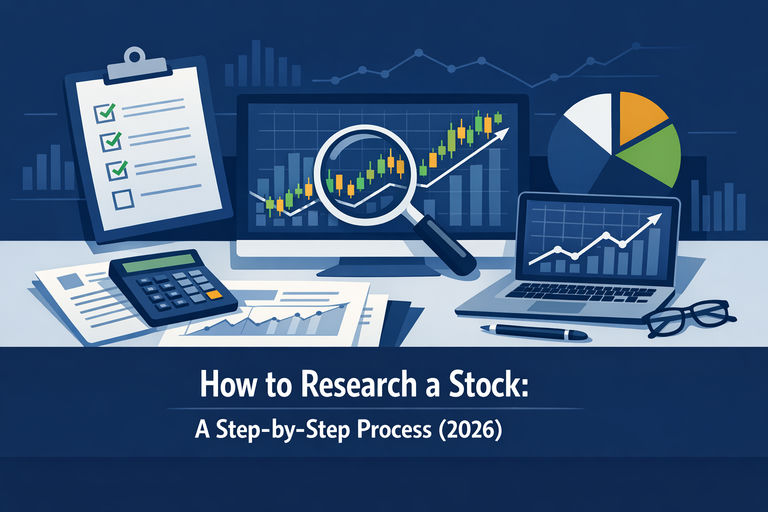
Most investors know they should research a stock before buying it. Far fewer have a consistent, repeatable process for actually doing it. The difference between a disciplined stock research process and a scattered one often shows up not in the stocks you pick, but in the ones you avoid — the ones that looked promising on the surface but fell apart under scrutiny. This guide walks through the best way to research stocks in 2026: a structured, step-by-step workflow that covers everything from initial screening to final conviction, designed for investors who want to think clearly and act deliberately.
Why a Structured Research Process Matters
Without a defined process, stock research tends to be reactive. You hear about a company, skim a few headlines, glance at a chart, and make a decision based on incomplete information. That approach might occasionally work, but it doesn't scale and it doesn't compound.
A structured investment research workflow forces you to ask the same questions about every company, in the same order, every time. This consistency does two things: it reduces the influence of cognitive bias (like excitement about a trending stock), and it makes your research comparable across different companies. When you've evaluated fifty companies the same way, you develop genuine intuition about what good looks like.
The steps below reflect how serious investors — from independent analysts to institutional portfolio managers — approach the problem of understanding a business before committing capital to it.
Step 1: Define Your Investment Criteria Before You Start
Before you research any specific stock, you need to know what you're looking for. This is the step most individual investors skip, and it's the one that causes the most trouble later.
Your investment criteria should reflect your goals, time horizon, and risk tolerance. Are you looking for high-growth companies that reinvest aggressively? Dividend-paying businesses with stable cash flows? Undervalued companies trading below intrinsic value? Each of these requires a different research lens.
Write down your criteria explicitly. For example:
- Revenue growth of at least 10% annually over the past three years
- Positive free cash flow for at least two of the last three years
- Return on equity above 15%
- Debt-to-equity ratio below 1.5
- Operating in an industry you understand
These criteria become your filter. Any company that doesn't meet them gets set aside, no matter how compelling the story sounds. This discipline is what separates a research process from a wishlist.
Step 2: Understand the Business Before You Touch the Numbers
One of the most common mistakes in stock research is jumping straight to financial metrics without first understanding what the company actually does. Numbers without context are just noise.
Start with the business model. How does the company make money? Who are its customers? What problem does it solve, and how does it solve it better than competitors? Is the revenue recurring or transactional? Is the business capital-intensive or asset-light?
Then move to the competitive landscape. Every business operates within an industry, and the structure of that industry determines how much pricing power any individual company can have. A company with a genuine competitive advantage — a strong brand, proprietary technology, network effects, or high switching costs — is fundamentally different from one competing purely on price.
Good sources for this qualitative research include:
- The company's annual report (10-K filing), particularly the business description and risk factors sections
- Earnings call transcripts, where management discusses strategy in plain language
- Industry reports and trade publications
- Competitor filings, which often describe the competitive environment candidly
This step takes time, but it's the foundation everything else is built on. If you can't explain how a company makes money in two or three sentences, you're not ready to evaluate its financials.
Step 3: Analyse the Financial Statements
Once you understand the business, the financial statements tell you whether the business is performing as well as the story suggests. This is the quantitative core of how to analyse stocks, and it covers three primary documents: the income statement, the balance sheet, and the cash flow statement.
Income Statement
Look at revenue trends over three to five years. Is the business growing, and is that growth accelerating or decelerating? Examine gross margins and operating margins — are they stable, expanding, or compressing? Margin trends often reveal competitive dynamics that aren't obvious from the headline numbers.
Balance Sheet
Assess the company's financial health. How much debt does it carry relative to its equity and earnings? Does it have enough liquidity to weather a downturn? A company with strong earnings but a fragile balance sheet can be far riskier than its income statement suggests. Look at companies like Microsoft (MSFT) or Johnson & Johnson (JNJ) as benchmarks for what fortress balance sheets look like in practice.
Cash Flow Statement
Many analysts consider free cash flow the most honest measure of a company's financial health, because it's harder to manipulate than reported earnings. Compare operating cash flow to net income over time. A company that consistently earns strong profits but generates weak cash flow deserves scrutiny.
Key metrics to calculate and compare against industry peers include:
- Price-to-earnings (P/E) ratio
- Price-to-free-cash-flow (P/FCF)
- EV/EBITDA
- Return on invested capital (ROIC)
- Net debt / EBITDA
Step 4: Evaluate Management and Corporate Governance
Financial statements reflect the past. Management determines the future. Evaluating the people running a business is one of the most underrated parts of the stock research process, particularly for long-term investors.
Look at the CEO's track record — not just at the current company, but across their career. Have they allocated capital well? Have they been transparent with shareholders when things went wrong? Do they own a meaningful amount of stock, aligning their interests with yours?
Proxy statements (DEF 14A filings) are a useful resource here. They disclose executive compensation structures, insider ownership levels, and board composition. A board dominated by insiders with no independent oversight is a governance red flag regardless of how attractive the financials look.
Pay attention to how management communicates. Executives who speak clearly about risks, acknowledge mistakes, and set realistic expectations tend to be more trustworthy than those who consistently overpromise. Reading two or three years of earnings call transcripts gives you a sense of whether management's guidance has been reliable.
Step 5: Assess Valuation
Understanding a business and admiring its financials is not the same as knowing whether the stock is worth buying at its current price. Valuation is the step that connects quality to price — and it's where many investors either overpay for great businesses or underestimate the risks embedded in cheap ones.
There is no single correct valuation method. Most serious analysts use several approaches and triangulate between them:
- Discounted cash flow (DCF) analysis — projects future free cash flows and discounts them back to present value. Highly sensitive to assumptions, but forces you to think explicitly about growth and risk.
- Comparable company analysis — compares valuation multiples (P/E, EV/EBITDA, P/S) to similar businesses in the same industry.
- Precedent transaction analysis — looks at what acquirers have paid for similar businesses, useful for understanding private market value.
The goal isn't to arrive at a precise number — it's to develop a range of reasonable values and assess whether the current market price sits inside, above, or below that range. A stock trading at a significant discount to your estimated intrinsic value offers a margin of safety; one trading at a large premium requires exceptional future performance just to justify its current price.
Step 6: Use the Right Stock Research Tools
A rigorous process is only as efficient as the tools supporting it. The right company research tools don't replace analytical thinking — they accelerate it by surfacing the data you need quickly and in a format that's easy to interpret.
Professional investors typically rely on a combination of:
- Financial data platforms — for accessing historical financials, ratios, and segment-level data across thousands of companies
- SEC filing databases — for reading primary source documents like 10-Ks, 10-Qs, and proxy statements directly
- Earnings transcript services — for reviewing what management has said on recent calls
- Screeners and filters — for narrowing a universe of thousands of stocks down to a shortlist that meets your criteria
- Portfolio analytics dashboards — for tracking how individual positions contribute to overall risk and return
Platforms like OpenBook Analytics are built around this kind of structured research workflow, bringing together quantitative data, screening capabilities, and analytical tools in one place — so investors can move through the research process without constantly switching between sources. What tools professional investors use has evolved significantly in recent years, with the best platforms now offering institutional-grade data that was previously inaccessible to independent investors.
Conclusion: Build the Process, Then Trust It
The best way to research stocks isn't about finding a secret formula or a single metric that predicts winners. It's about building a consistent, disciplined process that you apply to every company you evaluate — one that forces you to understand the business, interrogate the numbers, assess the people, and think carefully about price before you act.
That process won't eliminate uncertainty. No research process does. But it will make your decisions more deliberate, your thinking more rigorous, and your portfolio more reflective of genuine conviction rather than noise. Start with the steps above, refine them as you gain experience, and use the right tools to make the work faster and more thorough. Over time, the process itself becomes your edge.
You can Compare MSFT, JNJ side by side on Openbook, or find stocks with the screener.