Why it matters
Cheap on enterprise value to cash flow (EV/EBITDA). It is best used as a valuation shortlist, not a buy list: the strongest candidates still need balance-sheet, cash-flow and competitive-position checks.
%20--%3e%3csvg%20width='63.297821mm'%20height='39.29665mm'%20viewBox='0%200%2063.297821%2039.29665'%20version='1.1'%20id='svg8765'%20inkscape:version='1.1%20(c4e8f9ed74,%202021-05-24)'%20sodipodi:docname='OBALogoSingle2.svg'%20xmlns:inkscape='http://www.inkscape.org/namespaces/inkscape'%20xmlns:sodipodi='http://sodipodi.sourceforge.net/DTD/sodipodi-0.dtd'%20xmlns='http://www.w3.org/2000/svg'%20xmlns:svg='http://www.w3.org/2000/svg'%3e%3csodipodi:namedview%20id='namedview8767'%20pagecolor='%23ffffff'%20bordercolor='%23666666'%20borderopacity='1.0'%20inkscape:pageshadow='2'%20inkscape:pageopacity='0.0'%20inkscape:pagecheckerboard='0'%20inkscape:document-units='mm'%20showgrid='false'%20fit-margin-top='0'%20fit-margin-left='0'%20fit-margin-right='0'%20fit-margin-bottom='0'%20inkscape:zoom='1.1759259'%20inkscape:cx='179.85827'%20inkscape:cy='102.04724'%20inkscape:window-width='1920'%20inkscape:window-height='972'%20inkscape:window-x='0'%20inkscape:window-y='27'%20inkscape:window-maximized='1'%20inkscape:current-layer='layer1'%20/%3e%3cdefs%20id='defs8762'%20/%3e%3cg%20inkscape:label='Layer%201'%20inkscape:groupmode='layer'%20id='layer1'%20transform='translate(-31.351095,-50.101677)'%3e%3cpath%20style='fill:none;stroke:%233584e4;stroke-width:3.965;stroke-linecap:square;stroke-linejoin:round;stroke-miterlimit:4;stroke-dasharray:none;stroke-opacity:1'%20d='m%2077.07508,77.78787%2014.84134,8.87817%20V%2052.83397%20L%2034.08359,86.5521%20V%2053.69366%20l%2015.27351,9.31107'%20id='path8388'%20sodipodi:nodetypes='cccccc'%20/%3e%3c/g%3e%3c/svg%3e)
Cheap on enterprise value to cash flow (EV/EBITDA).
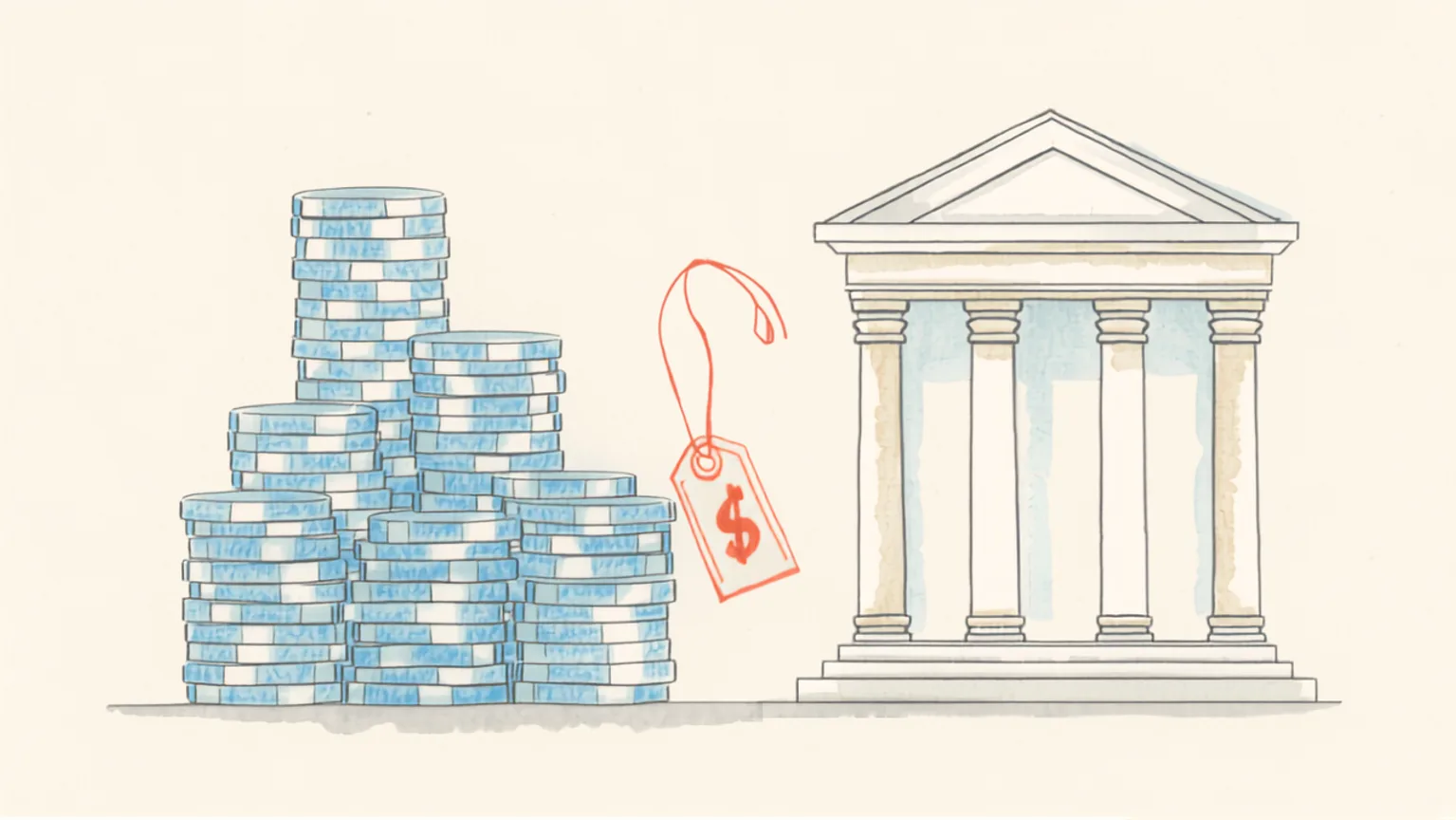
Judging value on cash flow rather than reported earnings avoids the distortions of accounting and leverage. This collection screens for companies trading at an EV/EBITDA of 8 or below — cheap relative to the cash their operations generate — ranked by market cap.
Cheap on enterprise value to cash flow (EV/EBITDA). It is best used as a valuation shortlist, not a buy list: the strongest candidates still need balance-sheet, cash-flow and competitive-position checks.
Look for durable margins, sensible debt, cash conversion and whether the market is pricing in a temporary problem or a permanent decline.
Cheap or high-quality screens can still contain value traps when earnings are peaking, accounting quality is poor or the business model is losing relevance.
Showing the 40 largest of 1328 — sort or filter to explore the rest.
Cheap on enterprise value to cash flow (EV/EBITDA). It currently holds 1328 stocks, each rated by Openbook's Reward and Risk scores. Judging value on cash flow rather than reported earnings avoids the distortions of accounting and leverage.
Constituents are chosen by a rules-based screen over the full UK and US common-stock universe, then ranked by market capitalisation.
It is rebuilt from live market data, so the constituents and their rankings update as prices and company fundamentals change — there is no fixed, hand-edited list.
Openbook's Reward rating combines a stock's growth, momentum, profitability and valuation into a single 0–100 score, and the Risk rating scores financial strength, volatility and size. Use them to compare names within this theme — broadly, a higher Reward alongside a lower Risk is more attractive. They are quantitative research signals, not investment advice.
Openbook Reward and Risk ratings and factor scores are quantitative signals for research, not investment advice. Data may be delayed. Some US-listed names carry partial factor coverage.