%20--%3e%3csvg%20width='63.297821mm'%20height='39.29665mm'%20viewBox='0%200%2063.297821%2039.29665'%20version='1.1'%20id='svg8765'%20inkscape:version='1.1%20(c4e8f9ed74,%202021-05-24)'%20sodipodi:docname='OBALogoSingle2.svg'%20xmlns:inkscape='http://www.inkscape.org/namespaces/inkscape'%20xmlns:sodipodi='http://sodipodi.sourceforge.net/DTD/sodipodi-0.dtd'%20xmlns='http://www.w3.org/2000/svg'%20xmlns:svg='http://www.w3.org/2000/svg'%3e%3csodipodi:namedview%20id='namedview8767'%20pagecolor='%23ffffff'%20bordercolor='%23666666'%20borderopacity='1.0'%20inkscape:pageshadow='2'%20inkscape:pageopacity='0.0'%20inkscape:pagecheckerboard='0'%20inkscape:document-units='mm'%20showgrid='false'%20fit-margin-top='0'%20fit-margin-left='0'%20fit-margin-right='0'%20fit-margin-bottom='0'%20inkscape:zoom='1.1759259'%20inkscape:cx='179.85827'%20inkscape:cy='102.04724'%20inkscape:window-width='1920'%20inkscape:window-height='972'%20inkscape:window-x='0'%20inkscape:window-y='27'%20inkscape:window-maximized='1'%20inkscape:current-layer='layer1'%20/%3e%3cdefs%20id='defs8762'%20/%3e%3cg%20inkscape:label='Layer%201'%20inkscape:groupmode='layer'%20id='layer1'%20transform='translate(-31.351095,-50.101677)'%3e%3cpath%20style='fill:none;stroke:%233584e4;stroke-width:3.965;stroke-linecap:square;stroke-linejoin:round;stroke-miterlimit:4;stroke-dasharray:none;stroke-opacity:1'%20d='m%2077.07508,77.78787%2014.84134,8.87817%20V%2052.83397%20L%2034.08359,86.5521%20V%2053.69366%20l%2015.27351,9.31107'%20id='path8388'%20sodipodi:nodetypes='cccccc'%20/%3e%3c/g%3e%3c/svg%3e)
How Stock Prices Are Determined: The Marginal Trade
Introduction: Why This Question Matters
"How are stock prices determined?" is one of the most common questions beginners have, yet it is also one of the most misunderstood.
When you look at a stock ticker, you might assume the price reflects the company's quality or its earnings. You might think that if a company is doing well, the stock must be going up.
In reality, stock prices are driven by market mechanics and expectations, not by the company's intrinsic merit.
Understanding this distinction is the foundation of becoming a rational investor. If you can grasp how prices are actually set, you will find the daily ups and downs of the market much less confusing.
The Short Answer: The Marginal Trade
To understand how a price is set, you need to look at the last trade that just happened.
Stock prices are determined by the highest price a buyer is willing to pay and the lowest price a seller is willing to accept at a given moment.
This specific transaction is known as the marginal trade. It is the "margin" of agreement between a buyer and a seller right now. Once this trade happens, that price becomes the market price.
An Example: The House Auction

Imagine a house going to auction. Thirty people are in the room. Bidding climbs to £400,000, then £405,000. You are willing to go to £420,000. The bidder next to you would have gone to £450,000 — but they never say so, because the bidding stops at £410,000 when everyone else drops out.
The hammer falls. The house is worth £410,000.
Not £420,000, which is what you'd have paid. Not £450,000, which is what the person beside you would have paid. Not £300,000, which is what the seller privately feared they'd get. The price is £410,000 because that is where one buyer and one seller actually transacted.
Every other opinion in that room — thirty people, thirty different valuations — is invisible to the recorded price. This is precisely how a share price works, except the auction never ends. The London Stock Exchange runs a continuous version of that room from 8:00am to 4:30pm, and the price you see quoted is simply the last time the hammer fell.
Price vs. Valuation: The Appraisal Analogy
Beginners often confuse Price with Valuation. These are two very different concepts.
Valuation is an estimate of what a business might be worth based on its assets, earnings, and future potential. Think of this like getting a professional appraisal for a house. It is a calculated guess.
Price is the amount the house actually sells for on the day. It is objective and real.
- Valuation is subjective and slow to change.
- Price is objective and changes every second.
Valuation influences price over the long term. If a company continues to grow, its valuation usually goes up, pushing the price higher. However, in the short term, Price ignores valuation completely. A company can be incredibly valuable, but if investors suddenly panic, the price can drop like a stone, regardless of the company's actual health.
The Marginal Buyer and Seller
Stock prices are not an average of what everyone thinks. They are not a vote or a survey.
They are set by the marginal buyer and the marginal seller — the last pair willing to trade.
This has a few important implications:
- One person can move a stock: If a large institutional investor suddenly decides to sell a massive amount of shares, they can push the price down.
- Long-term holders don't matter: If you hold a share for 20 years and believe it is worth £100, your opinion does not affect the price today. Only active traders moving money right now affect the price.
- Prices can change without news: If investors simply become less optimistic about the future, the "marginal seller" becomes willing to sell for a lower price, and the price drops.
Expectations: The Weather Forecast Analogy
Stock prices do not react to news itself; they react to surprises.
This is best understood through the lens of expectations. Before any news is released, the market has already built an expectation into the stock price.
Imagine the stock market is like a weather forecast. If the weatherman predicts a sunny day and it is sunny, you are not surprised. The market behaves similarly.
- If a company beats earnings estimates (good news), but the market expected an even bigger beat, the price might drop. Why? Because the news was a disappointment relative to expectations.
- If a company has a bad quarter, but the market expected it to be much worse, the price might rise. Why? Because the news was a surprise (relative to expectations).
Expectations are already embedded in the price before the news is released. Prices only move when reality differs from those expectations.
Supply and Demand: What Actually Counts
Supply and demand matter, but only active supply and demand matters.
What does NOT matter:
- Shares held by investors who aren't watching, or who have no intention of trading.
- Opinions expressed on social media without orders to back them up.
- Long-term beliefs that have no action attached to them.
What DOES matter:
- Buy orders and sell orders at specific price levels.
- The depth of liquidity (how many shares are available to buy/sell).
- The urgency of the participants.
Prices move when demand overwhelms supply at the margin, or when supply overwhelms demand. If you are the only person looking to buy a stock, but no one is selling, the price won't move until a seller appears.
Why Disagreement Drives Trading
If everyone in the world agreed on what a stock was worth, there would be no trades. If everyone agreed a share was worth £50, nobody would buy at £50 and nobody would sell at £50 — there would be no reason to bother.
Trades happen because there is disagreement.
- The buyer thinks: "This is undervalued at £50. I expect it to be worth £60."
- The seller thinks: "This is overvalued at £50, or I need the cash more than I need the shares."
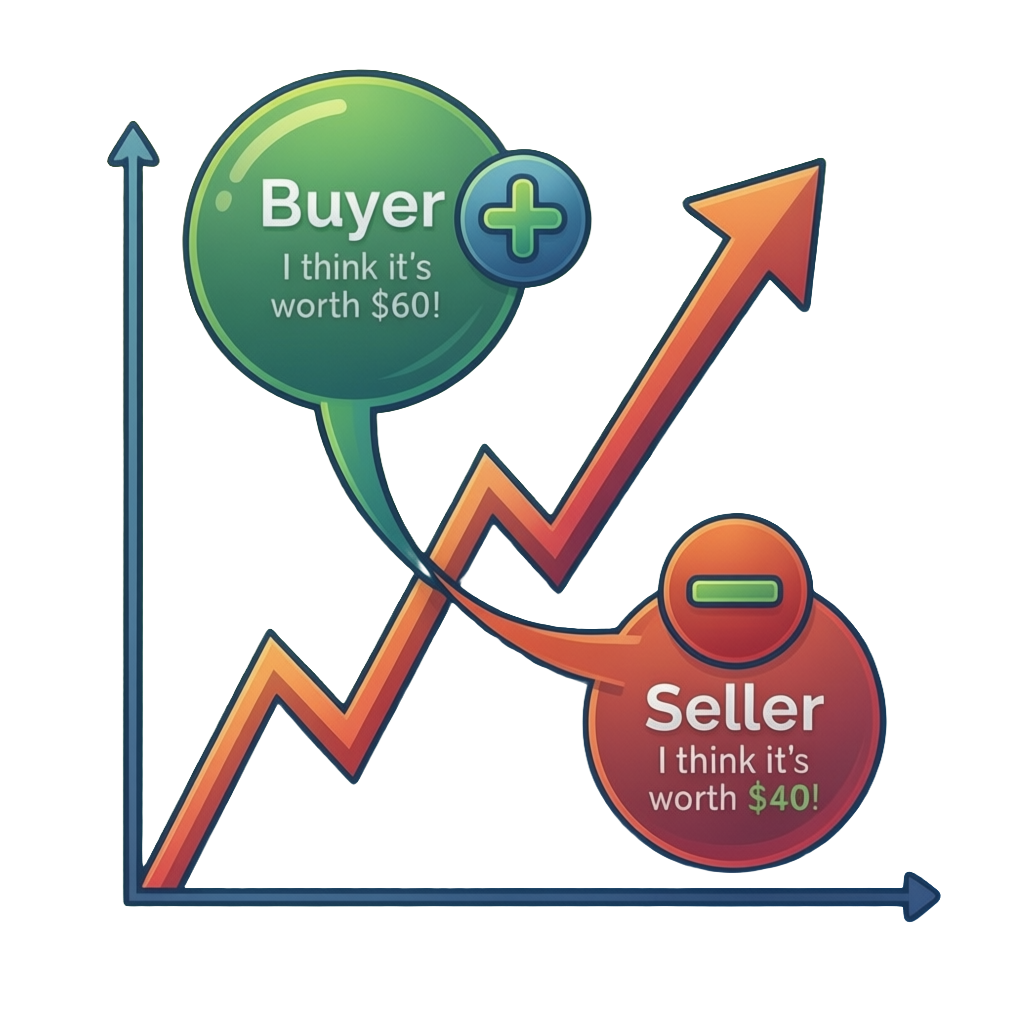
Every trade requires a buyer who believes the price will go up and a seller who believes it won't (or needs the cash). Volatility is evidence of disagreement, not market failure. Markets exist to resolve this disagreement over time, not to eliminate it instantly.
Key Takeaways
- The Marginal Trade: A stock price is set by the highest buyer and lowest seller willing to trade right now, regardless of what the company is "worth."
- Price vs. Valuation: Valuation is an estimate of worth; Price is the actual market price. Short-term prices can ignore valuation completely.
- Expectations Matter: Prices react to surprises, not news. If reality meets expectations, the price often stays the same.
- Active vs. Passive: Only active traders moving money right now affect the price. Long-term holders have no immediate influence on the market price.
- Disagreement is Key: Markets move because buyers and sellers disagree on value. When they agree on a price, a trade happens.