%20--%3e%3csvg%20width='63.297821mm'%20height='39.29665mm'%20viewBox='0%200%2063.297821%2039.29665'%20version='1.1'%20id='svg8765'%20inkscape:version='1.1%20(c4e8f9ed74,%202021-05-24)'%20sodipodi:docname='OBALogoSingle2.svg'%20xmlns:inkscape='http://www.inkscape.org/namespaces/inkscape'%20xmlns:sodipodi='http://sodipodi.sourceforge.net/DTD/sodipodi-0.dtd'%20xmlns='http://www.w3.org/2000/svg'%20xmlns:svg='http://www.w3.org/2000/svg'%3e%3csodipodi:namedview%20id='namedview8767'%20pagecolor='%23ffffff'%20bordercolor='%23666666'%20borderopacity='1.0'%20inkscape:pageshadow='2'%20inkscape:pageopacity='0.0'%20inkscape:pagecheckerboard='0'%20inkscape:document-units='mm'%20showgrid='false'%20fit-margin-top='0'%20fit-margin-left='0'%20fit-margin-right='0'%20fit-margin-bottom='0'%20inkscape:zoom='1.1759259'%20inkscape:cx='179.85827'%20inkscape:cy='102.04724'%20inkscape:window-width='1920'%20inkscape:window-height='972'%20inkscape:window-x='0'%20inkscape:window-y='27'%20inkscape:window-maximized='1'%20inkscape:current-layer='layer1'%20/%3e%3cdefs%20id='defs8762'%20/%3e%3cg%20inkscape:label='Layer%201'%20inkscape:groupmode='layer'%20id='layer1'%20transform='translate(-31.351095,-50.101677)'%3e%3cpath%20style='fill:none;stroke:%233584e4;stroke-width:3.965;stroke-linecap:square;stroke-linejoin:round;stroke-miterlimit:4;stroke-dasharray:none;stroke-opacity:1'%20d='m%2077.07508,77.78787%2014.84134,8.87817%20V%2052.83397%20L%2034.08359,86.5521%20V%2053.69366%20l%2015.27351,9.31107'%20id='path8388'%20sodipodi:nodetypes='cccccc'%20/%3e%3c/g%3e%3c/svg%3e)
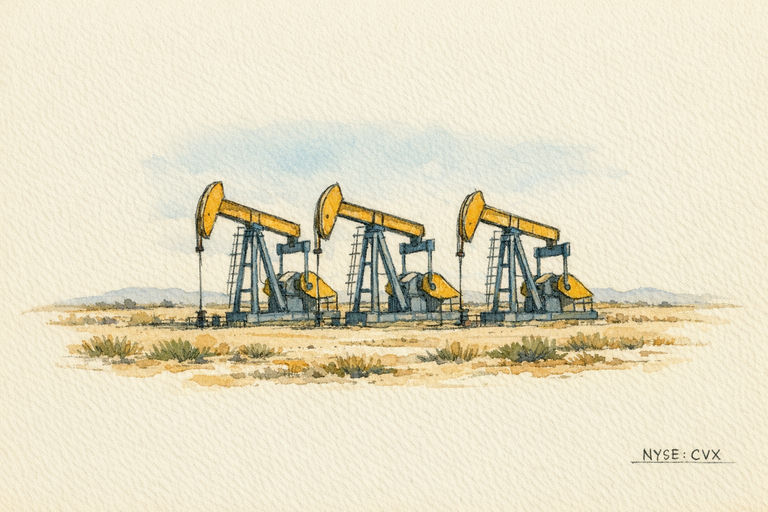
Any Chevron stock analysis has to begin with a simple observation: this is a company whose profits are made in two very different places. One is a set of oil and gas fields spread from West Texas to offshore Guyana to the steppe of western Kazakhstan. The other is a network of refineries, chemical plants and fuel marketing operations that buys crude and sells finished products. The two halves rarely move in the same direction at once, and understanding how they interact is the difference between reading Chevron Corporation (CVX) as a commodity bet and reading it as an integrated industrial business. What follows covers how Chevron earns its money, what its latest reported figures show, how it funds its dividend, and which variables would most change the picture.
How Chevron Makes Its Money
Chevron reports in two principal segments. Upstream finds and produces crude oil, natural gas and natural gas liquids, and it is where the overwhelming majority of both capital and earnings sit. Downstream refines crude into gasoline, diesel, jet fuel and lubricants, markets those products, and holds Chevron's 50 percent interest in Chevron Phillips Chemical Company, a petrochemicals joint venture that converts cheap North American gas liquids into plastics feedstocks.
The capital allocation tells you how lopsided the two are. Chevron's 2026 capital budget, announced on 3 December 2025, set organic capital expenditure for consolidated subsidiaries at $18 billion to $19 billion, with affiliate capital expenditure of a further $1.3 billion to $1.7 billion. Of that, roughly $17 billion is earmarked for upstream and only about $1 billion for downstream. Within upstream, around $7 billion is directed at global offshore work, principally Guyana, the Eastern Mediterranean and the Gulf of America, while close to $6 billion goes to US shale and tight assets across the Permian, DJ and Bakken basins. Total US spending is planned at about $10.5 billion, more than half the budget.
That mix matters for anyone reading the fundamentals. Upstream earnings are geared to the realized price of a barrel; downstream earnings are geared to the spread between crude input costs and refined product prices, which often widens exactly when crude weakens. The integrated structure is a deliberate hedge, and it is why Chevron's earnings profile behaves differently from a pure exploration and production company's.
The Permian Basin and the US Production Engine
The Permian Basin in West Texas and New Mexico is the single most important asset in Chevron's portfolio by volume, and in the second quarter of 2026 it sustained output above 1 million barrels of oil equivalent per day. Shale is a different business from offshore development: wells are cheap individually, decline steeply, and require continuous drilling to hold production flat. The advantage is flexibility, since capital can be dialed up or down within months rather than years, giving Chevron a shock absorber that long-cycle projects do not provide.
Alongside the Permian sit the DJ Basin in Colorado and the Bakken in North Dakota, the latter acquired through the Hess transaction. Together with the Gulf of America, these assets pushed total US net oil-equivalent production to a record of roughly 2.1 million barrels of oil equivalent per day in the second quarter of 2026. International production ran at close to 2 million barrels of oil equivalent per day over the same period, taking the worldwide figure to approximately 4.07 million barrels of oil equivalent per day, about 20 percent higher than a year earlier.
A twenty percent jump in production is not something a company of this size generates organically. Most of it came from the Hess acquisition, layered on top of underlying growth in the Permian and the Gulf of America. That distinction is worth holding onto: acquired growth and organic growth have very different implications for the years that follow.
The same West Texas gas resource is also being pushed into an adjacent market. On 22 June 2026 Chevron announced that its subsidiary Energy Forge One had signed a 20-year power purchase agreement with Microsoft (MSFT) for a co-located generation facility supplying a Microsoft-operated data center. Known as Project Kilby, it is expected to deliver approximately 2.67 gigawatts of natural-gas-fired capacity using turbines from GE Vernova (GEV) and Solar Turbines, with a final investment decision expected by the end of 2026 and first power anticipated in 2028. The logic is a contracted cash stream largely independent of the oil price cycle; the caveat is timing, since nothing has reached final investment decision and no revenue is expected before 2028.
Guyana, Kazakhstan and the International Portfolio
Chevron's international position is dominated by two names. The first is Guyana, where the Hess acquisition delivered a stake in the Stabroek Block, one of the most significant deepwater discoveries of the past two decades. Development there has proceeded in phases, with Yellowtail, the fourth development on the block, coming online during 2025 and contributing to volumes through into 2026. Deepwater barrels of this quality carry low unit operating costs and long production plateaus, which is precisely the profile that offsets the steep decline curves of shale.
The second is Tengizchevroil in Kazakhstan, in which Chevron holds the majority interest. During the second quarter of 2026 the third-generation plant there had its nameplate capacity raised from 260,000 to 320,000 barrels of oil per day following a low-capital debottlenecking exercise, pushing total field processing capacity above 1 million barrels per day. Debottlenecking is among the highest-return activities in the industry because it adds volume against infrastructure already paid for.
The counterweight is concentration risk. Kazakhstan is landlocked, and Tengiz crude reaches world markets largely through pipeline infrastructure crossing other jurisdictions. Guyana is a young producing nation with an evolving fiscal framework. Both are reasons to treat headline production growth as carrying geopolitical exposure alongside it.
What the Latest Reported Figures Show
Chevron reported its second-quarter 2026 results on 31 July 2026, and the numbers were unusually large. Net income came in at $12.1 billion, or $6.11 per diluted share, against $2.5 billion in the second quarter of 2025. Adjusted earnings were $12.0 billion, or $6.06 per diluted share, compared with $3.1 billion a year earlier. Total revenues and other income reached approximately $70.1 billion, up from about $44.8 billion, with sales and other operating revenues of $67.2 billion against $44.4 billion in the prior-year quarter.
Three forces drove that result simultaneously, which is why the year-on-year comparison looks so extreme: higher commodity prices, substantially higher volumes from the acquired Hess barrels, and improved refined product margins lifting downstream alongside upstream. Chevron also flagged roughly $1.4 billion of favorable timing effects within the quarter, a reminder that a single three-month period in this industry is a noisy signal rather than a run rate.
Cash generation followed earnings. Cash flow from operations was $22.6 billion in the quarter, against capital expenditure of about $4.5 billion, producing adjusted free cash flow of roughly $15.4 billion. On the cost side, management reported reaching $3 billion of annual run-rate structural cost reductions six months ahead of schedule, with more than 70 percent of the savings attributed to efficiency improvements rather than one-off actions. Separately, one year after closing the Hess transaction, Chevron reported capturing $1.5 billion of annual run-rate synergies, roughly 50 percent above its original target and six months earlier than planned.
Cash Returns, the Dividend and the Balance Sheet
For many holders, the dividend is the center of any Chevron stock analysis. The company pays a quarterly dividend of $1.78 per share, a 4 percent increase that extends a run of 39 consecutive years of annual dividend growth and annualizes to $7.12 per share. Against the closing share price of $196.83 on 31 July 2026, that equates to a yield of roughly 3.6 percent.
In the second quarter of 2026 Chevron paid $3.5 billion in dividends and repurchased approximately $3.0 billion of stock, returning around $6.5 billion to shareholders in total. Set against $15.4 billion of adjusted free cash flow, distributions were covered several times over in that quarter. The important caveat is that this was a quarter of unusually strong pricing and unusually strong volumes; coverage measured across a full cycle, including periods of weak crude, is the more meaningful test of a dividend in this sector.
The balance sheet strengthened materially. Chevron reduced total debt by $8.4 billion during the quarter. Its debt-to-cash-flow-from-operations ratio fell to 0.8 times from 0.9 times a year earlier, and net debt to cash flow from operations declined to 0.6 times from 0.8 times. Low leverage is not decorative for an oil major. It is the mechanism that lets a company keep paying and raising a dividend through a downturn without selling assets or cutting investment into a trough, which is how a 39-year streak survives multiple oil price collapses.
Risks and What Would Change the Picture
The dominant risk is the one that has always dominated: Chevron does not set the price of its main product. Realized prices for crude and gas are set by global supply and demand, OPEC+ policy and macroeconomic conditions, and a sustained move lower would compress upstream earnings quickly however well the assets are run. The scale of the year-on-year swing in the second quarter of 2026 illustrates that leverage in both directions.
Beyond price, several specific items are worth tracking:
- Sustainability of the volume step-up. Much of the 20 percent production increase came from acquired Hess barrels. The question for subsequent quarters is what underlying growth looks like once the acquisition has annualized in the comparatives.
- Guyana development pace. Stabroek is the principal long-cycle growth engine. Delays, cost inflation or changes to the fiscal terms would alter the production trajectory into the 2030s.
- Kazakhstan export routes. Tengiz volumes depend on export infrastructure that crosses borders. Disruption there affects realized volumes irrespective of field capacity.
- Downstream margin normalization. Refining margins are cyclical and were a positive contributor in the latest quarter. They do not stay elevated indefinitely.
- Capital discipline. Chevron set 2026 capex at the low end of its long-term $18 billion to $21 billion range. Whether that discipline holds as cash flow grows is a genuine test of management priorities.
- Permian reinvestment requirements. Shale requires continuous drilling to hold volumes flat. Sustaining capital in the Permian is a recurring obligation, not a discretionary one.
It is also worth placing Chevron alongside its peers rather than reading it in isolation. Exxon Mobil (XOM) shares its Permian and Guyana exposure, operating the Stabroek Block; Shell (SHEL) and BP (BP) carry different geographic weightings and downstream footprints. Comparing production growth, reinvestment rates and leverage across that group is usually more informative than examining a single quarter in isolation.
What to Watch From Here
A Chevron stock analysis conducted today has to sit with an awkward fact: the most recent quarter was extraordinary, and extraordinary quarters are poor guides to future ones. Net income of $12.1 billion, cash flow from operations of $22.6 billion and record production of roughly 4.07 million barrels of oil equivalent per day all reflect a rare alignment of high prices, acquired volumes and strong refining margins. The structural improvements underneath are more durable: $3 billion of run-rate cost reductions, $1.5 billion of Hess synergies ahead of schedule, a debottlenecked Tengiz, and net debt down to 0.6 times cash flow from operations.
The variables that would most change the picture are, in rough order of importance, the crude price, the pace of Guyana development, the durability of downstream margins, and whether capital spending stays inside its stated range. For income-focused readers, the metric to follow is not the headline yield but the coverage of the dividend by free cash flow across a full cycle, including quarters when the oil price is not cooperating. For those focused on growth, the question is what production looks like in 2027 and 2028 once the Hess contribution is fully lapped. The disclosures to judge that against are unusually clear; the work now is watching whether operational performance holds when prices are less generous.
Discussion
Log in to join the discussion