%20--%3e%3csvg%20width='63.297821mm'%20height='39.29665mm'%20viewBox='0%200%2063.297821%2039.29665'%20version='1.1'%20id='svg8765'%20inkscape:version='1.1%20(c4e8f9ed74,%202021-05-24)'%20sodipodi:docname='OBALogoSingle2.svg'%20xmlns:inkscape='http://www.inkscape.org/namespaces/inkscape'%20xmlns:sodipodi='http://sodipodi.sourceforge.net/DTD/sodipodi-0.dtd'%20xmlns='http://www.w3.org/2000/svg'%20xmlns:svg='http://www.w3.org/2000/svg'%3e%3csodipodi:namedview%20id='namedview8767'%20pagecolor='%23ffffff'%20bordercolor='%23666666'%20borderopacity='1.0'%20inkscape:pageshadow='2'%20inkscape:pageopacity='0.0'%20inkscape:pagecheckerboard='0'%20inkscape:document-units='mm'%20showgrid='false'%20fit-margin-top='0'%20fit-margin-left='0'%20fit-margin-right='0'%20fit-margin-bottom='0'%20inkscape:zoom='1.1759259'%20inkscape:cx='179.85827'%20inkscape:cy='102.04724'%20inkscape:window-width='1920'%20inkscape:window-height='972'%20inkscape:window-x='0'%20inkscape:window-y='27'%20inkscape:window-maximized='1'%20inkscape:current-layer='layer1'%20/%3e%3cdefs%20id='defs8762'%20/%3e%3cg%20inkscape:label='Layer%201'%20inkscape:groupmode='layer'%20id='layer1'%20transform='translate(-31.351095,-50.101677)'%3e%3cpath%20style='fill:none;stroke:%233584e4;stroke-width:3.965;stroke-linecap:square;stroke-linejoin:round;stroke-miterlimit:4;stroke-dasharray:none;stroke-opacity:1'%20d='m%2077.07508,77.78787%2014.84134,8.87817%20V%2052.83397%20L%2034.08359,86.5521%20V%2053.69366%20l%2015.27351,9.31107'%20id='path8388'%20sodipodi:nodetypes='cccccc'%20/%3e%3c/g%3e%3c/svg%3e)
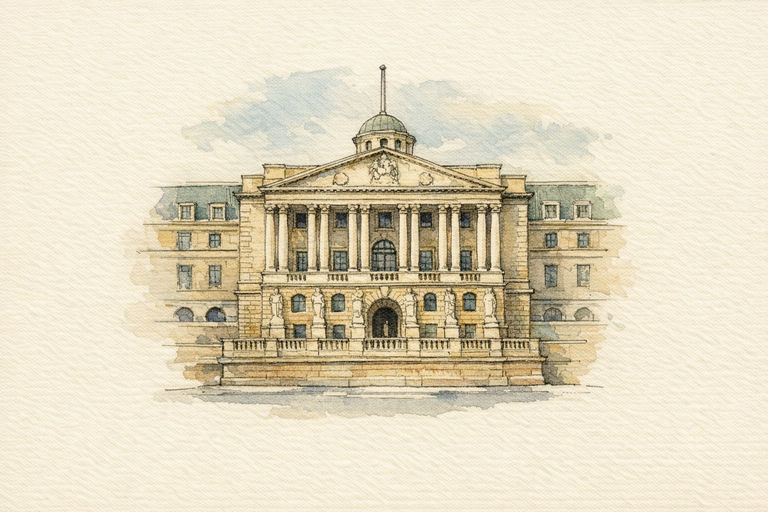
The Monetary Policy Committee next meets on 17 September, and three of its nine members are already on record wanting Bank Rate at 4%. At the meeting ending 29 July the vote was 6–3 to hold at 3.75%, with Megan Greene, Catherine Mann and Huw Pill in the minority for an immediate quarter-point rise. Nobody voted to cut.
The argument here is that the three hawks are wrong, and wrong for a specific and slightly counterintuitive reason. Britain is living through a real-income shock dressed as an inflation shock. Headline CPI is going to rise from here, quite possibly to something close to the Bank's projected peak of around 3.2% in the fourth quarter of 2026. But the reason it will rise is also the reason the Bank should not respond to it. This energy shock is being absorbed by households rather than smoothed by the Treasury, and a shock absorbed by households destroys demand. Raising Bank Rate into that would be tightening on top of a contraction the gas bill is already delivering free of charge.
The hawkish case, put as well as it can be put
It is not a silly case. Crude and refined product prices remain well above pre-conflict levels five months after the Islamic Revolutionary Guard Corps announced the closure of the Strait of Hormuz to US and Israel-allied shipping on 2 March. Andrew Bailey himself flagged that the risks to energy prices lie to the upside, citing the possibility of repeated resumptions of conflict, European gas stocks below their usual level, and a fall in global refining output.
Services inflation was still 3.6% in the twelve months to June, down only a tenth from 3.7% in May. That is the wage-sensitive half of the basket and it is not obviously converging on anything consistent with 2%. The hawks' worry is the familiar one: let a headline peak above 3% sit in the data for two or three quarters and it stops being a relative price and starts being an expectation. On that reading, 25 basis points now is cheap insurance against 150 later.
The transmission mechanism the hawks need no longer exists
Second-round effects are not a mood. They are a mechanism, and the mechanism runs through pay. In 2022 it worked because the labour market was tight enough that workers could ask for the shock back and get it. In 2026 it cannot work, because they cannot.
Annual growth in regular pay excluding bonuses was 3.4% in the three months to May, the third consecutive period at that rate. Not decelerating, but not accelerating either – pinned, at a level the Bank has itself described as consistent with target. Total pay including bonuses ran at 4.4% in the three months to February to April. Meanwhile payrolled employment fell by 138,000, or 0.5%, between April 2025 and April 2026.
Put those together. A workforce that is shrinking on the payroll count and whose regular pay growth has not budged through five months of war and a 65% single-month rise in Brent – the largest monthly gain in the benchmark's history – is not a workforce about to win an energy-driven pay round. The hawks are guarding a door that is already bolted.
Why this shock prints hotter and hurts more at the same time
Here is the part that most commentary misses, because it treats fiscal policy and the inflation print as separate subjects.
In 2022 the state stood between the wholesale gas price and the household. The Energy Price Guarantee capped what people paid, and because CPI measures what people actually pay, that intervention mechanically suppressed measured inflation. The shock was enormous and the print, bad as it was, understated it. The Bank was flattered by the fiscal design.
In 2026 the design has flipped. Rachel Reeves has said that support with energy bills pushed up by the Iran war will be based on household income, and hinted that it may not arrive until the autumn. Targeted, income-tested support does not lower the price cap. It transfers cash to the households most at risk of hardship – defensible policy – but it leaves the measured price of energy exactly where the market puts it, and it leaves the median household paying it in full.
So the same size of underlying shock now produces a higher CPI print and a larger hit to aggregate real income than it would have in 2022. The number on the screen goes up precisely because the cushion has been removed. Reading that number as evidence of overheating gets the sign wrong. Ofgem's cap for a typical household rose 13% to £1,663 for 1 July to 30 September, and the Q4 cap is confirmed on 26 August. Every pound of that increase that is not subsidised is a pound not spent elsewhere. Household consumption grew just 0.1% in the first quarter of 2026, before most of this landed.
The oil round trip is already in the post
The hawks are also fighting a price that has spent the past three months going backwards. Brent opened January near $60.75 a barrel, reached $116.29 on 9 March and touched roughly $126 intraday on 30 April. By mid-July the September contract settled at $84.95. On 3 August Brent was $83.51 and West Texas Intermediate $79.87; within two sessions Brent had traded below $79 and WTI toward $75, a fall of more than 10%, on reports that Washington, Tehran and Muscat are close to a 60-day interim agreement to reopen the waterway without tolls. A Houthi attack on a Saudi vessel in the Red Sea steadied prices mid-week, which tells you the path is not clean.
UK forecourts have not caught up. Average pump prices were 161.4p a litre for petrol and 181.5p for diesel on 6 August, against 156.1p and 174.0p on 27 July. That is the July crude spike arriving at the pump with its usual lag, and it is why the autumn prints will look bad. But it is a lag, not a trend. Note also that the diesel premium is doing most of the work – this is a distillate and refining shock more than a household heating shock, which means it lands first on freight and business costs, exactly the sort of margin squeeze that suppresses activity rather than igniting a wage round.
The gilt market has already worked this out. The ten-year yield sat at 4.89% on 5 August, its lowest since 10 July, having fallen as the Hormuz headlines improved. Market-implied pricing puts the probability of no hike at all this year around 64.5%. A Reuters poll of 65 economists found a majority expecting 3.75% through year end, though close to 40% still see at least one rise and only six a cut.
The best argument against me is European gas storage
I do not want to win this by ignoring the strongest counter, which is not oil at all. It is gas, and it is genuinely worrying.
EU storage stood at 57.15% of capacity on 2 August, the lowest reading for early August in records going back to at least 2009 to 2011. Germany was around 47% and the Netherlands lower still. The binding EU target for 1 November has already been softened from 90% to 80% and even that looks demanding. TTF front-month traded near €56.65 per megawatt hour on 3 August, having hit a three-and-a-half year high of €63.70 on 24 July, and sits roughly 70% above a year ago.
A cold November into an 80% target that Europe misses is a different article from this one. Gas is what drives the Ofgem cap, the cap is the single most powerful line in the UK CPI basket, and unlike oil it has no obvious diplomatic off-ramp. If that is the world we get, headline inflation will not peak at 3.2% and I will have been too relaxed.
But note that even in that scenario the hawkish conclusion does not automatically follow. A worse gas winter makes the real-income squeeze deeper, not shallower. It strengthens the case for looking through the print, unless it comes with evidence that pay is responding – and that is the thing to watch, not the print itself.
What would change my mind
This view is falsifiable, and here is what falsifies it.
- Pay. Regular pay growth excluding bonuses breaking convincingly above roughly 4.5% having sat at 3.4% for three consecutive periods. That is the second-round mechanism switching back on, and it would settle the argument against me.
- Services. CPI services reaccelerating back through 4% from 3.6%, on breadth rather than one or two administered categories.
- Employment. The payroll count turning back up while energy costs stay high. A labour market that can absorb an energy shock without shedding jobs is a labour market with pricing power.
- Gas. EU storage failing to reach the 80% target by 1 November with TTF sustained above the July high, and the Hormuz interim deal collapsing rather than extending.
Absent those, the September meeting should hold, the three dissents should not become five, and by the turn of the year the harder question facing this committee will not be whether it hiked too late. It will be whether it held too long.
Discussion
Log in to join the discussion