%20--%3e%3csvg%20width='63.297821mm'%20height='39.29665mm'%20viewBox='0%200%2063.297821%2039.29665'%20version='1.1'%20id='svg8765'%20inkscape:version='1.1%20(c4e8f9ed74,%202021-05-24)'%20sodipodi:docname='OBALogoSingle2.svg'%20xmlns:inkscape='http://www.inkscape.org/namespaces/inkscape'%20xmlns:sodipodi='http://sodipodi.sourceforge.net/DTD/sodipodi-0.dtd'%20xmlns='http://www.w3.org/2000/svg'%20xmlns:svg='http://www.w3.org/2000/svg'%3e%3csodipodi:namedview%20id='namedview8767'%20pagecolor='%23ffffff'%20bordercolor='%23666666'%20borderopacity='1.0'%20inkscape:pageshadow='2'%20inkscape:pageopacity='0.0'%20inkscape:pagecheckerboard='0'%20inkscape:document-units='mm'%20showgrid='false'%20fit-margin-top='0'%20fit-margin-left='0'%20fit-margin-right='0'%20fit-margin-bottom='0'%20inkscape:zoom='1.1759259'%20inkscape:cx='179.85827'%20inkscape:cy='102.04724'%20inkscape:window-width='1920'%20inkscape:window-height='972'%20inkscape:window-x='0'%20inkscape:window-y='27'%20inkscape:window-maximized='1'%20inkscape:current-layer='layer1'%20/%3e%3cdefs%20id='defs8762'%20/%3e%3cg%20inkscape:label='Layer%201'%20inkscape:groupmode='layer'%20id='layer1'%20transform='translate(-31.351095,-50.101677)'%3e%3cpath%20style='fill:none;stroke:%233584e4;stroke-width:3.965;stroke-linecap:square;stroke-linejoin:round;stroke-miterlimit:4;stroke-dasharray:none;stroke-opacity:1'%20d='m%2077.07508,77.78787%2014.84134,8.87817%20V%2052.83397%20L%2034.08359,86.5521%20V%2053.69366%20l%2015.27351,9.31107'%20id='path8388'%20sodipodi:nodetypes='cccccc'%20/%3e%3c/g%3e%3c/svg%3e)
Understanding Market Capitalisation: A Clear, Modern Guide
Market capitalisation is one of the most quoted — and most often misunderstood — concepts in the world of investing. You see it everywhere: on stock screeners, in daily financial headlines, in "largest companies" lists, and in the breakdown of major indices like the FTSE 100 and the S&P 500. Yet, many retail investors treat it as a simple shortcut without truly grasping what it measures, what it leaves out, and how professionals actually interpret it.
This guide is designed to be a comprehensive, reference-grade explanation of market capitalisation. It is meant to be a clear lesson on what market cap really represents, how it functions in practice, and why it is not the same thing as a company's value. By the end of this lesson, you should be able to use this metric with confidence and clarity.
What Is Market Capitalisation?
At its simplest level, market capitalisation (often abbreviated as "market cap") is the total market value of a company’s publicly traded equity. It is the price the market is currently willing to pay for a slice of that specific business.
Definition: Market capitalisation represents the aggregate value the stock market assigns to a company’s equity at a given moment in time.
The Basic Formula
To understand how this number is derived, you don't need a complex accounting degree. The formula is straightforward and logical:
Market Capitalisation = Share Price × Shares Outstanding
A worked example. Suppose a company has:
- 1 billion shares in issue, and
- a share price of 250p (£2.50).
Multiply the two: £2.50 × 1,000,000,000 = £2.5 billion.
One UK-specific gotcha: LSE shares quote in pence, not pounds. If you multiply 250 by a billion you get 250 billion pence, which is £2.5bn — divide by 100. Forgetting this is how new investors end up believing a mid-cap is a £250bn giant.
This figure is static in the moment you calculate it, but it changes constantly throughout the trading day as the share price fluctuates.
Why Does Market Capitalisation Exist?
Before market cap became the standard way to measure company size, investors had to rely on confusing metrics like a stock's nominal price or total revenue. These methods were often misleading and made it hard to compare companies fairly.
Market cap exists to answer a single, essential question: How big is this company in the context of the market?
It normalises size into a single, comparable metric. Take two real FTSE 100 companies with very different-looking share prices:
- Company A has 50 million shares trading at £100 each → 50,000,000 × £100 = £5 billion
- Company B has 10 billion shares trading at £1 each → 10,000,000,000 × £1 = £10 billion
Company A's shares cost a hundred times more than Company B's. Company B is nonetheless twice the size.
This is not a contrived example. Lloyds Banking Group trades in pence with tens of billions of shares in issue; AstraZeneca trades in thousands of pence with a fraction as many. Both sit in the FTSE 100, and the one with the far lower share price is not the smaller company. The number of shares a company has chosen to issue is an accident of its history — it tells you nothing at all about how big the business is.
"This share is only 45p, it's cheap" is the single most common beginner error on UK share forums. A 45p share can belong to a £30bn company or a £3m shell. Share price on its own is meaningless — you need market cap for size, and a valuation ratio like P/E for cheapness. They are three different questions.
Market Cap Is Not Company Value
One of the most critical distinctions you must learn is that market capitalisation is not the same thing as a company's value. This is a common pitfall for beginners.
Market cap reflects the market's current pricing of equity. It is influenced by investor sentiment, future expectations, liquidity, and narratives. It does not directly measure the hard assets a company owns, its debt levels, or its intrinsic worth.
Market cap does not tell you:
- How much cash is sitting in the bank.
- The total amount of debt the company owes.
- The difference between assets and liabilities.
- Whether the company is currently profitable.
This distinction is foundational. When you see a high market cap, you are seeing the market's guess about that company's future, not a reflection of its current balance sheet reality.
How Investors Use Market Capitalisation
In the real world, market cap is rarely used in isolation. It is primarily a classification and risk-context tool that helps investors organise a portfolio.
Risk Profiling
Market cap is heavily tied to risk. Generally speaking, larger companies tend to be more stable, while smaller companies tend to be more volatile. This is a structural tendency rather than a guaranteed rule, but it is a useful starting point for assessing risk.
Portfolio Construction
Fund managers and individual investors often use market cap to build a diversified portfolio. They might allocate a portion of their money to "Large-Cap" (blue-chip) stocks for stability, a portion to "Mid-Cap" for growth, and a portion to "Small-Cap" for potential high returns.
Index Weighting
Most major stock indices are market-cap weighted. This means the biggest companies have a massive influence on the index's performance. In the FTSE 100, the largest handful of companies make up a disproportionate share of the total index value simply because they are so big. This is why the headline index can rise on a day when most of its constituents fall.
Market Capitalisation Categories Explained
While definitions can vary slightly depending on the region, the following framework is the standard used by investors globally.
Large-Cap Companies
- Typical size: £6bn+ in the UK (broadly the FTSE 100); $10bn+ under US conventions
- Characteristics: These are established, mature businesses with a long history of operations. They usually have high liquidity (easy to buy and sell), extensive analyst coverage, and a strong market presence.
- Examples: Shell, AstraZeneca, HSBC, Unilever. In the US, Apple and Microsoft.
Mid-Cap Companies
- Typical size: roughly £500m to £6bn in the UK (the FTSE 250); $2bn–$10bn in the US
- Characteristics: These companies are often in an expansion phase. They have moved past the startup stage and are growing, but they haven't yet reached the massive scale of the titans. They often offer a balance of growth potential and stability.
Small-Cap Companies
- Typical size: roughly £50m to £500m (the FTSE SmallCap and the larger end of AIM)
- Characteristics: These are earlier-stage or niche players. They are often faster-growing but carry higher risk. They may have less liquidity and fewer resources than larger firms.
Micro-Cap & Nano-Cap Companies
- Typical size: below £50m — most of AIM and the FTSE Fledgling
- Characteristics: These companies are the smallest listed entities. They are often thinly traded, have limited disclosure (less financial information available), and are highly sensitive to market sentiment and liquidity.
Why the tiers matter. They map to liquidity as much as to risk. An AIM micro-cap can move 20% on a single sizeable retail order, because there simply aren't enough shares changing hands to absorb it. A FTSE 100 name will barely register the same order. That difference shows up as a wider bid-ask spread — a real, immediate cost every time you trade a smaller company.
The Market Cap Illusion

Market capitalisation measures consensus pricing, not economic substance. This leads to a phenomenon known as the "Market Cap Illusion."
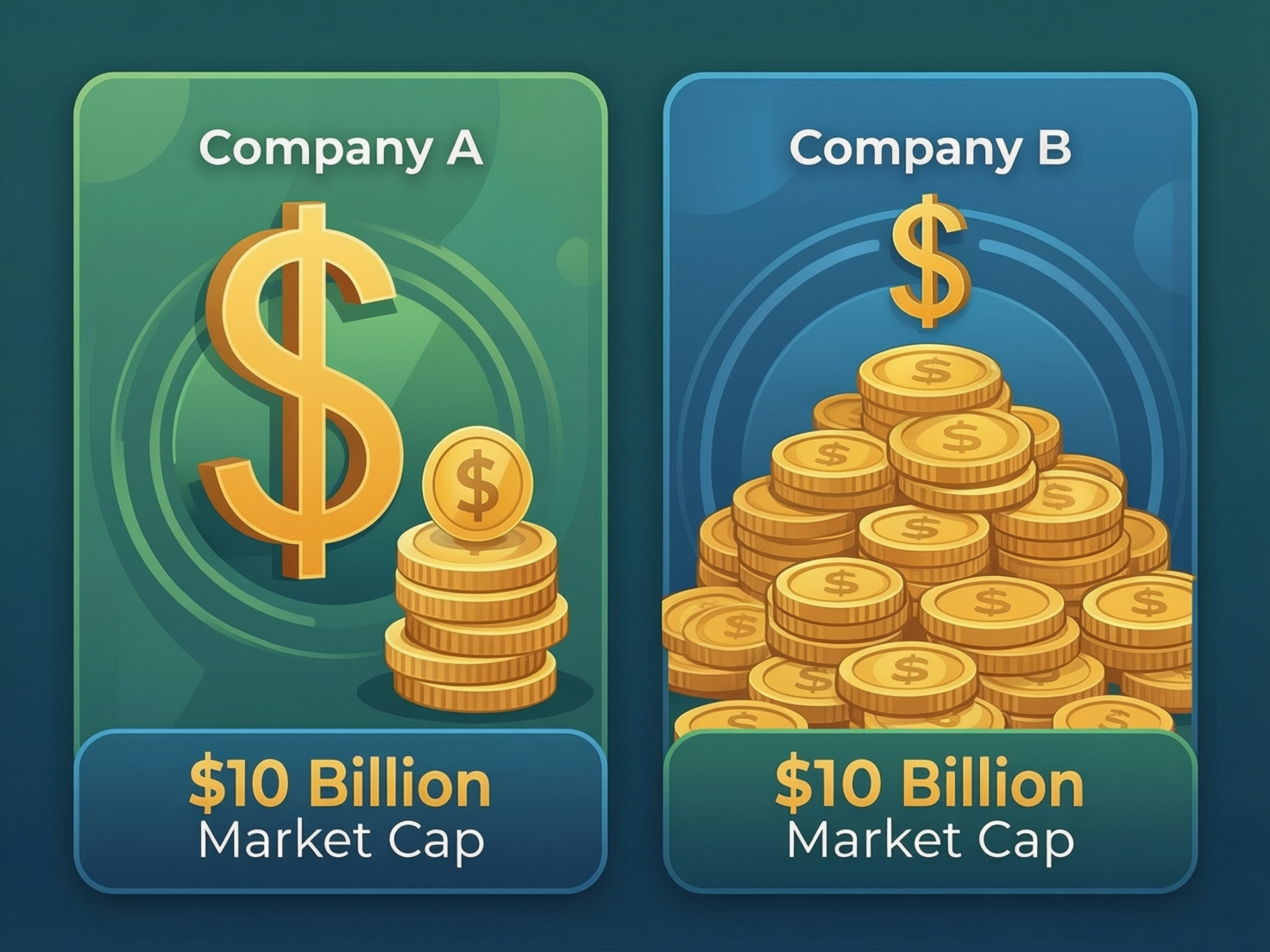
Two companies can share the exact same market cap of £10 billion while being fundamentally different businesses:
- One company might be profitable, sitting on a mountain of cash, and have no debt.
- The other company might be losing money, carrying heavy debt, and burning through cash.
To the market cap calculation, they are both "worth" £10 billion. This can be confusing for retail investors. It teaches us that market cap measures size (how much equity you would buy), but it does not measure health (financial strength or profitability).
Market Capitalisation vs. Enterprise Value
When professionals want to evaluate a business more accurately, they often look at Enterprise Value (EV) instead of Market Cap.
Market cap looks at the equity alone. Enterprise Value looks at the entire business — including its debt and its cash.
| Metric | Includes Debt? | Includes Cash? | Primary Use |
|---|---|---|---|
| Market Capitalisation | No | No | Equity size / Market sentiment |
| Enterprise Value | Yes | Yes | Business value / M&A potential |
- Market Cap answers: How does the market price the equity?
- Enterprise Value answers: What is the market pricing the entire business at?
Using the wrong metric can lead to bad decisions. For example, if a company has a huge amount of cash and very little debt, its Market Cap might look expensive, but its Enterprise Value might actually be quite cheap.
How Market Cap Changes Without the Business Changing
Here is an important lesson for the patient investor: Market cap can change dramatically even when nothing inside the company changes.
Because market cap is driven by sentiment, interest rates, and index flows, it can spike or drop based on external factors. If the Bank of England cuts interest rates and investors turn optimistic, a company's market cap might jump 10% in a single day. This doesn't mean the company suddenly invented a new product or made more money; it simply means investors are willing to pay more for their shares.
This is why market capitalisation is best understood as a real-time market signal rather than a static balance sheet fact.
Why Size Slows Growth
Very large companies tend to grow more slowly in percentage terms, and the reason is arithmetic rather than management failure.
A £50m company doubling to £100m needs to find £50m of additional value — a large contract, a successful product, a single good year. A £150bn company doubling needs to find another £150bn, which means creating an entire FTSE-100-sized business from scratch. The bigger the base, the more the world has to change for the percentage to repeat.
This is why smaller companies can post far higher percentage growth while larger companies dominate the indices but compound more steadily — and why the Size factor shows up in risk models on both sides of the ledger.
Market Capitalisation and Stock Indices
Understanding market cap is essential for understanding how stock indices move. Most major indices — the FTSE 100, the FTSE 250 and the S&P 500 among them — are market-cap weighted: the bigger the company, the more of the index it accounts for.
(One well-known index is not. The Dow Jones Industrial Average is price-weighted, so a company with a high share price sways it more than a larger company with a low one. It's a historical quirk, and it's why professionals rarely quote the Dow.)
This structure creates a specific dynamic:
- A small number of large companies can drive overall index performance.
- The index return may look nothing like the return of the average constituent.
- Headline market performance can mask widespread internal weakness.
The FTSE 100 makes the point sharply. Its top ten constituents typically account for something like half the entire index by weight. A strong day for Shell, AstraZeneca, HSBC and Unilever can lift the headline number while the majority of the other ninety companies fall. "The FTSE was up today" is a statement about a handful of very large businesses, not about UK plc.
What Market Cap Does Not Tell You
Finally, it is vital to know the limitations of the metric. Market capitalisation does not tell you:
- Whether a stock is cheap or expensive (you need a valuation metric like P/E for this).
- Whether the business is financially healthy (check the balance sheet for debt).
- Whether future returns will be high or low.
- The quality of management.
Market cap is descriptive, not predictive. It describes the current size of the company. It does not predict its future success.
Key Takeaways
To wrap this up, here are the core points to remember:
- It measures size: Market cap is simply Share Price × Shares Outstanding. It tells you how big a company is in the eyes of the market.
- It's not value: Market cap is the market's consensus on equity price, not the company's intrinsic value or financial health.
- EV complements it: When looking at valuation, combine market cap with Enterprise Value to account for debt and cash.
- It moves with sentiment: Market cap shifts with interest rates and investor psychology, not just business performance.
- Use it for context: Market cap is best used as a classification tool (Large vs. Small) and a risk lens, not as a signal to buy or sell on its own.
Disclaimer: This lesson is for educational purposes only and does not constitute financial advice. Always do your own research before making investment decisions.